Autism Test: Free Online Autism Spectrum Test for Adults
A 40-question autism test covering social communication, routine, sensory experience, focused interests, masking and planning.
- What this autism test measures
- What autism actually is
- What “spectrum” really means
- How online autism tests work
- Do online autism tests actually work?
- Every major autism test, with pros and cons
- The clinical instruments
- Why 40 questions
- The six areas explained
- Why we built it this way
- How scoring works
- What a score cannot tell you
- Who this test suits
- Getting a fair result
- What to do with your result
- Other tests on this site
- Frequently asked questions
What this autism test measures
This autism test asks about everyday experience. Not knowledge, not ability, not personality. It asks what conversation costs you, how change affects you, how your senses behave in a busy room, how deeply you follow an interest, how much effort you spend appearing ordinary, and how easily you start things.
Those six areas are where decades of research keep landing. Two map directly onto the formal diagnostic criteria. The other four cover ground the older questionnaires handle badly or skip entirely.
Each question is answered on a five-point scale. At the end you get a figure out of 100 plus a separate score for each area. The six-area profile is the more useful half, and most people skim straight past it.
What autism actually is
Autism is a developmental difference in how the brain processes social information, sensory input and change. It is lifelong. It is present from early childhood by definition, even when nobody recognised it until decades later.
Current diagnostic criteria group the features into two areas. The first is persistent differences in social communication and social interaction. The second is restricted or repetitive patterns of behaviour, interests or activities, which explicitly includes sensory differences.
Both must be present, both must have been present since early development, and both must cause meaningful difficulty in daily life. That last requirement catches people out. Traits alone are not enough. Someone can have a high trait count and a life arranged well enough that nothing goes wrong, and they would not meet criteria.
Around one to two per cent of people are autistic, though estimates vary with how and where you count. Recognition has risen sharply, particularly among adults and among women, which reflects better identification rather than a change in prevalence.
What autism is not
It is not an illness and there is nothing to cure. It is not caused by parenting, screens, diet or vaccines. It is not a single severity dial running from mild to severe. It is not the same as an intellectual disability, though the two can co-occur. And it is not rare.
What “spectrum” really means
Almost everyone pictures this wrongly. The common image is a line running from “a bit autistic” to “very autistic”, with each person placed somewhere along it.
That is not what a spectrum means here. It means a profile across several separate dimensions. Social communication, sensory processing, language, executive function, need for routine and intensity of interest are all distinct, and an autistic person can sit at very different points on each.
One person may speak fluently and find supermarkets unbearable. Another may need daily communication support while being untroubled by noise. They are not at different points on one line. They have different shapes.
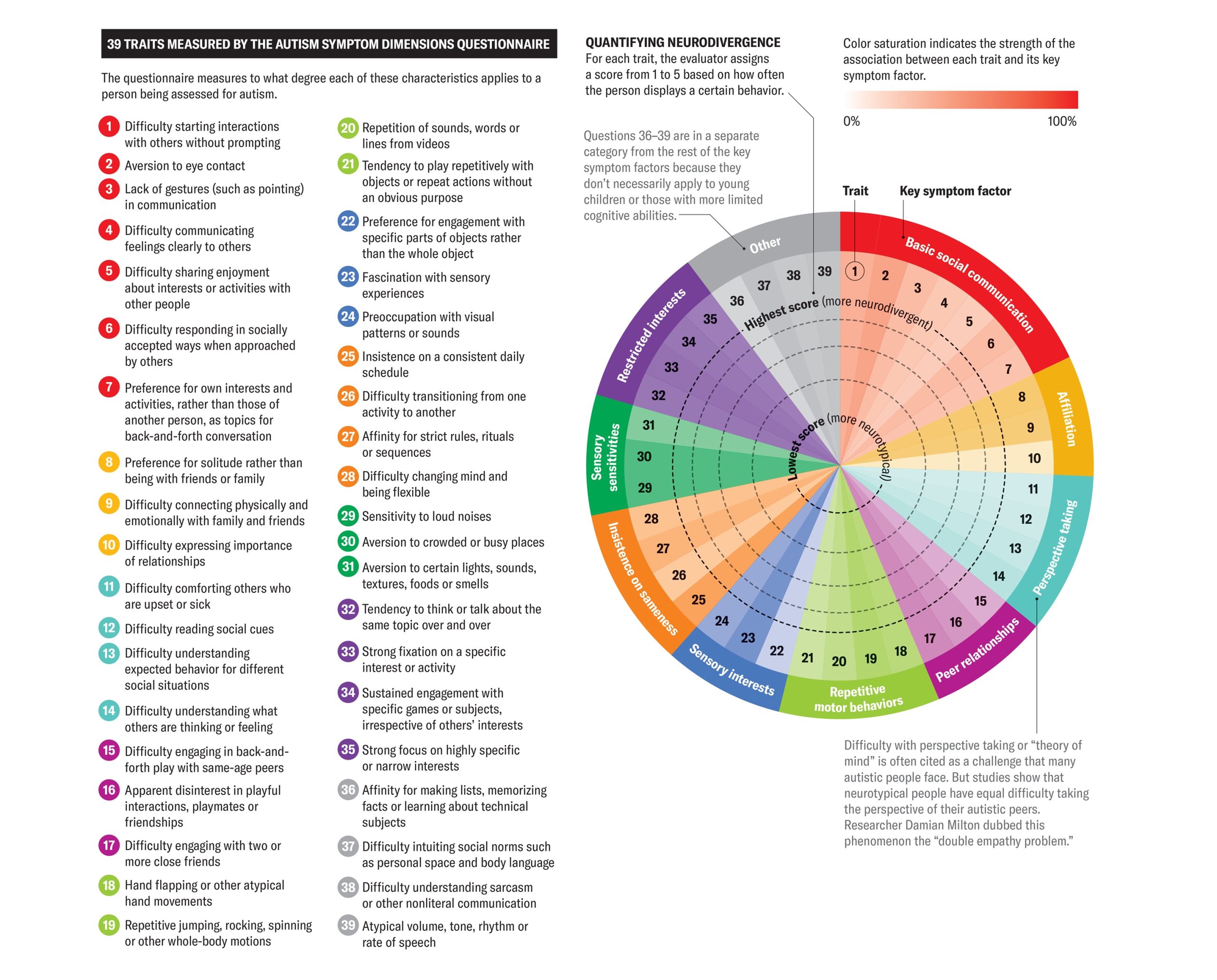
This is why “but you do not seem autistic” is a meaningless sentence. It is also why the six-area profile in your result matters more than the total. Two people scoring 58 on this autism test can have almost nothing in common in terms of what produced that number.
It also explains why support needs change with circumstance. The same person may need nothing in a quiet structured job and a great deal in an open-plan office with shifting demands. How disabling autism is depends heavily on the environment it has to operate in.
How online autism tests work
Every online autism test does the same basic thing. It converts subjective experience into numbers.
You read a statement. You rate how strongly it applies. Each answer contributes points. The points are totalled and compared against something, either a published threshold or a set of descriptive bands.
The better instruments add two refinements. They reverse the wording on some items, so that people who agree with everything do not automatically score highly. And they report subscale scores rather than one figure, because the pattern carries more information than the total.
Two statistics describe how well any screening test performs. Sensitivity is the proportion of autistic people it correctly flags. Specificity is the proportion of non-autistic people it correctly clears. A test can have excellent sensitivity and useless specificity, which means it catches everyone who is autistic and also flags almost everybody else. That combination is common, and it is why a positive screen means far less than people assume.
Do online autism tests actually work?
Partly. The honest answer has four parts, and anyone telling you otherwise is selling something.
They work as a prompt
This is their real value and it is genuinely significant. Most adults who reach a questionnaire like this have spent years sensing that social life costs them more than it seems to cost other people. Seeing those experiences written down as discrete, nameable items is often the first moment the pattern becomes visible as a pattern rather than a personal failing. That is worth something even when the score itself is unremarkable.
They work reasonably at the extremes
Very low and very high scores carry real information. Someone who answers “never” to nearly all forty statements is unlikely to be autistic. Someone who answers “always” to nearly all of them is reporting a pattern that is uncommon in people who are not.
They work badly in the middle
The middle is where most people land, and it is where a questionnaire helps least. A score of 50 tells you very little on its own. This is the range where the area profile matters and the total does not.
They fail at the thing people most want
They cannot distinguish autism from the conditions that resemble it. This is not a flaw in any particular instrument; it is a limit of self-report. ADHD, social anxiety, complex trauma, long-term burnout and chronic illness all produce answers that look autistic on paper.
The clearest demonstration comes from the RAADS-R, one of the two most respected adult questionnaires. Its original study reported 97 per cent sensitivity and 100 per cent specificity. When a UK team later gave it to adults on a specialist service waiting list, specificity came out at 3 per cent. Ninety-eight per cent of the group scored above the threshold and only 34 per cent were diagnosed. We go through that research in detail in our guide to the RAADS-R test.
Every major autism test, with pros and cons
If you have been reading about this for any length of time you will have met a handful of acronyms. They were built for different purposes, different ages and different questions. Here is what each is actually for.
AQ, the Autism Spectrum Quotient
Fifty items, developed at the Autism Research Centre in Cambridge and published in 2001. It covers social skill, attention switching, attention to detail, communication and imagination. It is the most cited autistic-trait measure in the research literature.
Pros. Enormous research base. Quick at ten to fifteen minutes. Freely available for non-commercial use. Well understood, so a score means something to a clinician.
Cons. Validated largely on men. Does not ask about masking at all. Asks only about the present, missing lifelong patterns. Several individual items have been criticised as culturally narrow. Its threshold of 32 is debated.
AQ-10
Ten items drawn from the same Cambridge work. In the UK it appears in NICE guidance as a brief referral aid, so a GP can run it in two minutes and decide whether to refer.
Pros. Extremely fast. Endorsed in clinical guidance. Good at its actual job, which is opening a door.
Cons. Far too short to describe anyone. High false-positive rate. Frequently misread by the public as a verdict when it was only ever a triage tool.
RAADS-R
Eighty items, published in 2011, written specifically for adults who reached adulthood undiagnosed. Its distinguishing feature is that it asks about your whole life rather than only now.
Pros. The lifetime framing is genuinely valuable and almost unique. Four subscales give a profile. Free for non-commercial use. Often the instrument adults are pointed toward after a brief screen comes back positive.
Cons. Long, and many people abandon it. Specificity collapses in clinical populations, as low as 3 per cent in one study. Does not ask about masking. Recent analyses suggest the four subscales are not statistically independent. Relies on accurate memory of childhood.
RAADS-14
A fourteen-item short form of the RAADS-R, built for busy psychiatric outpatient services.
Pros. Fast. Validated in a psychiatric population, which is where screening is hardest.
Cons. Specificity of 46 to 64 per cent, so roughly half of non-autistic people screen positive. Loses the subscale detail entirely.
CAT-Q, the Camouflaging Autistic Traits Questionnaire
Twenty-five items measuring compensation, masking and assimilation. Published in 2019.
Pros. Measures the thing every other instrument ignores. Invaluable for understanding why someone’s difficulties are invisible from outside. Particularly relevant for women and late-diagnosed adults.
Cons. It is not an autism screen and cannot be used as one. Non-autistic people mask too, for other reasons. Only useful alongside something else.
Our 40-question test
Pros. Covers masking as one of six areas rather than ignoring it. Reports a six-area profile instead of a single number. Forty items is enough to sample each area properly without the abandonment rate of an eighty-item instrument. One question per screen, so no scanning ahead. Free, instant, no account.
Cons. No published validation study, so no comparison against a normed sample and no defensible cut-off. Self-report, so it inherits every limitation above. Written for adults, so it suits teenagers and children poorly.
The clinical instruments
These are not questionnaires you take alone. They are the tools that actually produce diagnoses, and they are worth knowing about so you understand what an assessment involves.
ADOS-2. A structured observational assessment delivered face to face by a trained clinician, using tasks and conversation rather than questions on paper. Considered one of the strongest tools available. Its weakness is that it can miss people who mask well, because it depends on observable behaviour.
ADI-R. A long structured interview with a parent or caregiver, focused on early development. Excellent for establishing the childhood history the criteria require. Impractical when parents are unavailable or recollection is poor.
MIGDAS-2. A sensory and language-based interview, increasingly preferred for adults and for women. Designed to surface internal experience rather than observable behaviour, which makes it better at detecting masked presentations.
SRS-2. A rating scale completed by parents and teachers. Its strength is capturing behaviour across two different settings, and the gap between home and school reports is often the most revealing part of the picture.
M-CHAT-R. Twenty items completed by parents of toddlers aged sixteen to thirty months, used at routine health checks. Valuable for early identification. High false-positive rate on its own, which is why a positive screen leads to assessment rather than a diagnosis.
Why 40 questions
Length is a trade-off. Short questionnaires get finished. Long ones measure more reliably.
The AQ-10 takes two minutes and has ten items. It exists purely to decide whether a referral is worth making. The RAADS-R has eighty items and takes twenty minutes, measures considerably more, and loses a lot of people halfway through.
Forty sits between them deliberately. It is enough to give each of the six areas a real sample rather than one or two questions. It is short enough to finish in about eight minutes.
Seven of the forty are worded in reverse. On those, agreeing scores fewer points rather than more. That matters because people tend to agree with statements put in front of them, and reverse items break the pattern. Tapping straight down one column does not produce a dramatic result here.
The six areas explained
| Area | Questions | What it looks at |
|---|---|---|
| Social communication | 10 | Turn-taking, reading intent, literal interpretation, joining groups, phone calls, how friendships form |
| Routine and change | 6 | Short-notice changes, order of doing things, transitions, need for advance detail |
| Sensory experience | 7 | Sound, light, texture, smell, crowded spaces, repeated movement |
| Focused interests | 5 | Depth of interest, noticing patterns, absorption, ordering and listing |
| Masking and recovery | 6 | Copying social behaviour, rehearsing conversation, self-monitoring, recovery time |
| Starting and planning | 6 | Task initiation, switching, vague instructions, time estimation, noticing your own state |
Social communication gets ten questions because it covers the widest range of experience. Each area is reported as a percentage of its own maximum, so you can compare them directly despite the different question counts.
Why we built it this way
Four decisions shaped this autism test, and each has a reason behind it.
Original questions rather than a copy
The AQ, AQ-10, RAADS-R and CAT-Q are all owned by their authors and licensed for non-commercial use only. Rather than reproduce them, which a great many sites do without permission, the questions here are written from scratch around the same trait areas the research identifies. Nobody owns the underlying constructs.
The honest trade-off: original questions mean no validation study and no defensible cut-off. We think a clearly labelled original instrument beats an unauthorised copy of a validated one, but you should know which you are taking.
Masking as its own area
This is the gap we most wanted to close. The AQ does not ask about masking. Neither does the RAADS-R. That omission is the single biggest reason both under-detect women and adults diagnosed late.
Masking and social difficulty can move in opposite directions. Someone who has spent twenty years studying how other people behave may report that conversation is manageable, because by now it is rehearsed. They may simultaneously report that it exhausts them completely. A single social score averages those into nothing. Two separate scores show the actual shape. If this is your situation, our female autism test weights these items more heavily again.
A profile instead of a verdict
Single-number results invite misreading. People remember “64” and forget everything around it. Six area scores are harder to reduce to a label and carry considerably more information.
Bands rather than a cut-off
A threshold would imply this questionnaire can detect autism. It cannot. The validated instruments have thresholds because they were tested against thousands of people over years, and even those are disputed. Inventing one here would be dishonest.
How scoring works
Every answer is worth 0 to 4 points. Forty questions gives a maximum of 160, converted to a figure out of 100.
Because of the reverse items the practical range is narrower than it looks. Answering neutrally throughout gives about 50. Agreeing strongly with everything gives about 82, not 100. Disagreeing with everything gives about 18.
| Score | Band | What it indicates |
|---|---|---|
| 0 to 20 | Very few traits | Almost none of the forty statements described you. |
| 21 to 35 | Few traits | Some traits, at a level common across the general population. |
| 36 to 52 | Some traits | A noticeable cluster. The area scores matter more than the total here. |
| 53 to 68 | Many traits | A substantial number reported across several areas. |
| 69 to 100 | A high number of traits | Nearly every statement applied to you. |
What a score cannot tell you
Whether you are autistic. No questionnaire can establish that, including the validated ones.
That you are not autistic. A low score is weak evidence, because masking suppresses the answers a questionnaire depends on.
Autism rather than something resembling it. ADHD, social anxiety, trauma, burnout and chronic illness all push these scores up.
Whether it matters. The criteria require real difficulty in daily life, not just the presence of traits.
Who this test suits
Adults, roughly eighteen and over. The wording assumes working life, long-term patterns and years of accumulated self-knowledge.
Teenagers should use a version written for them, because adolescence produces many of these experiences in people who are not autistic. For children under about thirteen a parent-report instrument is the right tool, since young children cannot compare their inner experience against anybody else’s.
Getting a fair result
Answer for how things normally are. Not for today. A bad week pushes every score up.
Go with your first instinct. Over-thinking an item usually means answering how you think you ought to.
Do not answer as the version of yourself you perform. This is the hardest instruction and the most important, particularly if you mask heavily.
Finish in one sitting if you can. Answers save as you go, so stopping is fine, but mood drift between sessions affects consistency.
What to do with your result
Nothing is required. Many people take an autism test, find the language useful, and go no further. That is a complete outcome.
If you want to go further, the number is not the useful part. Write down three or four specific incidents for each area that scored highly. Real events, with what happened and what it cost you. A clinician can work with “I left a job because of an open-plan office”. Nobody can work with a score.
Then find out what you were like as a young child if you can. The criteria require traits present from early development. A parent’s recollection, an old school report or a sibling’s memory all count for more than a questionnaire.
Other tests and guides on this site
Female Autism TestWeighted toward masking and the presentation most often missed in women.
Autism Test for TeenagersReworded around school, friendship groups and family life.
Am I Autistic QuizThe same questions, framed as the question most people actually type.
Autism Test for AdultsThe full 40-question version, written around adult working and social life.
Masking TestCamouflaging specifically, for people whose difficulties are invisible.
Frequently asked questions
Is this autism test free?
Yes, completely. No payment, no email address, no account, and no paywall at the end. Your result appears immediately.
How many questions is it?
40 questions across six areas. Each appears on its own page, so you answer one at a time rather than scrolling a long list.
How long does it take?
About eight minutes. There is no timer. Answers save as you go, so you can stop and return.
Can an online autism test diagnose me?
No. Diagnosis requires a clinician, a developmental history and usually several hours. A questionnaire indicates whether that process is worth starting.
Which is the most accurate autism test?
Among free self-report instruments, the AQ and the RAADS-R have the largest research bases, and the RAADS-R takes a lifetime view that the others lack. Neither performs well in clinical populations, and neither asks about masking. There is no single most accurate option, which is why comparing two or three is more useful than trusting one.
What is the difference between an autism test and an autism spectrum test?
Nothing meaningful. The phrases are used interchangeably, and “spectrum” simply reflects the current diagnostic name.
How accurate is this test compared with the AQ or RAADS-R?
Those two have published validation and this one does not, which is a real advantage this test cannot claim. What it covers that they do not is masking, and it reports a profile rather than a single number. Treat any instrument’s score as indicative rather than final.
Why is each question on its own page?
One question at a time removes the temptation to scan ahead and answer by pattern. It also makes the test usable on a phone without endless scrolling.
What if I score low but still think I am autistic?
Trust that. Screening instruments systematically miss people who mask well, and by adulthood masking is often invisible even to the person doing it. Your experience is better evidence than a questionnaire.
What if I score high?
It means you reported a substantial number of autistic traits. That could reflect autism. It could also reflect ADHD, anxiety, trauma or burnout, which a questionnaire cannot separate. If the result matches your experience of your whole life rather than just recently, it is worth pursuing.
Does autism show up differently in women?
Often, yes. Masking tends to begin earlier and work better, focused interests are more often socially ordinary in subject matter, and difficulties get attributed to anxiety or personality instead. Our female autism test weights these items more heavily.
Can I take it more than once?
Yes. First answers are usually the most accurate because they are the least considered. If you retake it after a long gap and get a different number, that gap generally reflects how your week has gone.
Is autism the same as Asperger’s?
Asperger’s syndrome was merged into autism spectrum disorder in 2013, because clinicians could not apply the boundary consistently and language delay turned out not to predict later outcomes. Anyone assessed today is assessed against autism criteria. Many people diagnosed before the change still use the older term, which is their choice.
Do you store my answers?
Your answers stay in your own browser for the length of your visit so the score can be calculated. We do not ask for your name, your email address or anything that identifies you.
Should I get a formal diagnosis?
It depends what you need. A diagnosis is genuinely useful for workplace or educational adjustments, for accessing some services, and for certainty. It can also be slow, expensive and emotionally demanding. Many adults find self-identification serves them perfectly well, and acting on the profile rather than the label costs nothing and needs nobody’s permission.
More Autism and Aspergers Tests.
Official RAADS R Test website.
Am I Austistic Quiz website.
Official Aspergers Test website.
RAADS-R Test at MyAutismTests.com
CPS Test – Test your Click Speed
IQ Test for Kindergarteners – Test your Child’s IQ.